
At the Archives
I still had some concerns. Had I selected the right files? Could I locate information about my grandfather by reviewing only a quarter of the materials? Although it seemed unlikely, I decided it was worth the effort.
At the archives, researchers may use cell phones to photograph files and records. I photographed all the documents I intended to review, as well as others that clarified key aspects of the project. These images allowed me to continue my research after leaving the Archives. When my time ended, I returned the boxes to the archivist, gathered my belongings, and departed for the airport. I was pleased to find my grandfather’s name in the Manhattan Project records and that he held two very important roles, he was the Inspecting Engineer at Chapman Valve in Springfield, MA. In August 1944, he joined the Tennessee Eastman Corporation as the Boston Area Field Office representative for all projects at Oak Ridge, Tennessee
I arrived at the National Archives in Atlanta early Monday afternoon, completed the required paperwork, and began my review. By closing at 4 pm, I had examined three boxes, which was slightly less than I had anticipated for a half day.
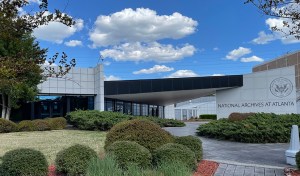
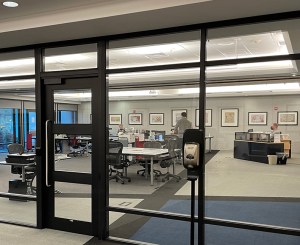
I was pleased to find my grandfather’s name in the second box, listed among Stone and Webster employees working on the Manhattan Project for the week ending July 3, 1943. He served as the resident inspector at Chapman Valve Company in Indian Orchard, Massachusetts. This confirmed I was searching in the correct location.
Back at the hotel, I checked the finding aid for files on Chapman Valve Company and requested five additional boxes. On Tuesday morning, I learned the extra boxes would be available on Thursday due to vacation schedules. I reviewed eight boxes on Tuesday and twelve on Wednesday. While I did not find specific information about my grandfather, I discovered that the first order of Chapman Valve Co. vacuum valves was scheduled for delivery in September 1943. This aligns with when my grandfather transitioned to a desk job and returned his “C” gas card, as noted in the letters.
Chapman Valve Company
On Thursday, I reviewed 12 boxes, and while I found nothing directly related to Mac, I did learn that Chapman Valve Co. contracts were classified as top secret in the contract rating documents. On Thursday evening, I reviewed and identified the order in which I wanted to review the remaining 16 or so boxes I had waiting for me on Friday. I was beginning to think that my fantastic find on Monday might not be repeated, but it would be nice to find something else.
Metal Hydrides
A document I found initially confused me. It looked like my grandfather visited Metal Hydrides, Inc., “… was a part of the Manhattan Project until about 1947. During this time, MHI worked with natural uranium-238 to produce metal powder. This powder was then molded into ingots and sent to other nuclear facilities in Chicago, Hanford, and Oakridge (now known as Oak Ridge). These facilities used the ingots for fuel experimentation.“ (https://primaryresearch.org/a-study-of-the-metal-hydrides-companys-involvement-in-the-development-of-the-atom-bomb/)
In reality, a paper vendor working for the D. L. Macdonald Company was visiting Metal Hydrides.
Access Permission
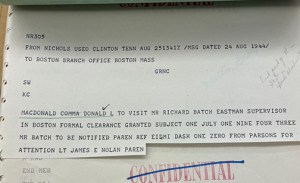
I came across a teletype dated August 24, 1944, granting my grandfather access to the Eastman Supervisor in Boston, backdated to July 1, 1943. The order was signed by Colonel K. D. Nichols, the District Engineer “. . . of the Manhattan Engineer District at Oak Ridge, Tennessee, and led both the uranium production facility at the Clinton Engineer Works at Oak Ridge, Tennessee, and the plutonium production facility at Hanford Engineer Works in Washington state.” (https://en.wikipedia.org/wiki/Kenneth_Nichols)


4 responses to “Uncovering Family History: My Grandfather’s Engineering Legacy”
This has been amazing to read. My grandfather was an engineer at Chapman Valve and one of the employees tasked with top secret MP work. My understanding is he worked on valve designs and production. But he was also gone for a very long trip. My mom recalls her dad arriving at their home in a vehicle stripped of the exterior front body (open air driving) and a large lead box welded to the back trunk area. With the uranium work that Chapman Valve also completed along with valve work (rod production is my understanding from the USGov health settlements) a large lead box makes sense. He was home just to say good-bye with an awareness of the possibility he may not return. He was gone for quite a long time as my mom would recall. As I dig through family files, I hope to find out more information. I do have my grandfather’s Manhattan Project certificate, but I do not think we still have his atomic pin. I recall him using it as a fishing weight which is a story for another day.
Thank you for reading and for your comments. That is an amazing story to tell about the lead box and not seeing your grandfather being away with the possibility of never returning. I like how he used the A-Pin as a fishing weight too. These men did a lot and, in the end, the pin wasn’t something you could wear around the house but had many other uses.
William Bill Shackleford, received a certificate from the United States of America. Of when he helped design the Trigger mechanism of the atomic bomb. I was told that me and my siblings could received Royalties from our grandfather how do i get a copy of that certificate
Hi Cathy,
Thanks for reaching out. My research was conducted by searching through records at the National Archives. I’m not sure how you would access that certificate today. Have you reached out to the Department of Energy?
Best,
Anne