
What did we know?
Because we never met him, information about Mac came from my grandmother, my father, my uncle, and the letters. Each family member focused on rather specific memories. My grandmother spoke about the love letters Mac had sent her. She promised us that we would be able to read them one day.
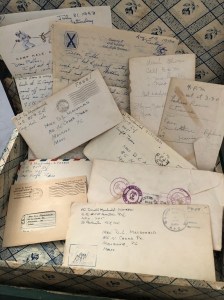
As I noted in my post, The Green Box, my grandmother kept love letters and postcards from Mac, along with 140 or so letters my uncle wrote home during his 3-year stint in the 10th Mountain Division from March 1943 to March 1946, along with the sympathy cards she received at the time of Mac’s death. And the letters provide a sense of the times during which this was happening as well as the daily activities of each family member, including Mac. The sympathy cards provide a snapshot of how people perceived Mac, dedicated to seeing the war-related, top-secret project he was working on to its conclusion no matter how exhausting, so the boys, including his oldest son, would come home sooner. A cousin, who was 13 or so when the war ended, remembers his father, my grandmother’s cousin, switching off the cheering crowds on the radio on VJ Day, August 14-15, 1945, to say a prayer for Uncle Mac because he would never see how his work had turned out. He had died less than a month before the first bomb was dropped.


4 responses to “Uncovering Family History: My Grandfather’s Engineering Legacy”
This has been amazing to read. My grandfather was an engineer at Chapman Valve and one of the employees tasked with top secret MP work. My understanding is he worked on valve designs and production. But he was also gone for a very long trip. My mom recalls her dad arriving at their home in a vehicle stripped of the exterior front body (open air driving) and a large lead box welded to the back trunk area. With the uranium work that Chapman Valve also completed along with valve work (rod production is my understanding from the USGov health settlements) a large lead box makes sense. He was home just to say good-bye with an awareness of the possibility he may not return. He was gone for quite a long time as my mom would recall. As I dig through family files, I hope to find out more information. I do have my grandfather’s Manhattan Project certificate, but I do not think we still have his atomic pin. I recall him using it as a fishing weight which is a story for another day.
Thank you for reading and for your comments. That is an amazing story to tell about the lead box and not seeing your grandfather being away with the possibility of never returning. I like how he used the A-Pin as a fishing weight too. These men did a lot and, in the end, the pin wasn’t something you could wear around the house but had many other uses.
William Bill Shackleford, received a certificate from the United States of America. Of when he helped design the Trigger mechanism of the atomic bomb. I was told that me and my siblings could received Royalties from our grandfather how do i get a copy of that certificate
Hi Cathy,
Thanks for reaching out. My research was conducted by searching through records at the National Archives. I’m not sure how you would access that certificate today. Have you reached out to the Department of Energy?
Best,
Anne