
Research
How to begin?
From 2017 to early 2020, I copied, scanned, and read every letter and sympathy card I could find, hoping to learn more about my grandfather and his role in the Manhattan Project. I also wanted to see how our family got through WWII, especially how my uncle did in the 10th Mountain Division. By following the names, places, and events mentioned, I figured out where Mac was, what he was doing, and connected events from the Manhattan Project to what the letters said about Mac and his work.
After reviewing all the letters, I wanted to gather more information. My next step was to check if he appeared in any original Manhattan Project records, especially those from Oak Ridge, Tennessee. Most Manhattan Project records are kept at the National Archives. Searching archives.gov, I discovered that these records are stored in different regional branches, depending on where the work was conducted. For example, most Oak Ridge files are at the Atlanta branch, which covers the Southeastern United States. Files from the Office of the Chief Engineer in Boston are mainly at the Boston branch, with some also in Atlanta. The more sensitive files are stored at the College Park, Maryland, facility.
National Archives Boston
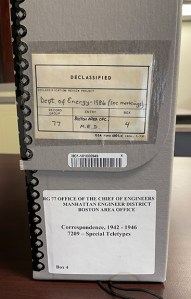
My first visit was to the Boston office in spring 2018, where I examined records from the Office of the Chief Engineer, Army Corps of Engineers, covering 1942 to 1946. Although I found nothing directly connected to my grandfather, I gained valuable insights into the establishment of the Manhattan Project office in Boston, the quick assignment of tasks, the acquisition of buildings, and the large monthly increases in staffing, especially of draughtsmen and women.
National Archives College Park
In August of 2018, I accompanied my husband on a business trip to Washington, DC. While he attended a conference, I spent two days at the National Archives at College Park, Maryland, which holds documents from across the project, particularly sensitive, and some still restricted, even more than 75 years later. With just two days devoted to this search and one full day spent on the thousands of photographs of Oak Ridge, Tennessee, I did not turn up anything directly related to my grandfather.
 A. E. Macdonald's Writing Life
4 responses to “Uncovering Family History: My Grandfather’s Engineering Legacy”
This has been amazing to read. My grandfather was an engineer at Chapman Valve and one of the employees tasked with top secret MP work. My understanding is he worked on valve designs and production. But he was also gone for a very long trip. My mom recalls her dad arriving at their home in a vehicle stripped of the exterior front body (open air driving) and a large lead box welded to the back trunk area. With the uranium work that Chapman Valve also completed along with valve work (rod production is my understanding from the USGov health settlements) a large lead box makes sense. He was home just to say good-bye with an awareness of the possibility he may not return. He was gone for quite a long time as my mom would recall. As I dig through family files, I hope to find out more information. I do have my grandfather’s Manhattan Project certificate, but I do not think we still have his atomic pin. I recall him using it as a fishing weight which is a story for another day.
Thank you for reading and for your comments. That is an amazing story to tell about the lead box and not seeing your grandfather being away with the possibility of never returning. I like how he used the A-Pin as a fishing weight too. These men did a lot and, in the end, the pin wasn’t something you could wear around the house but had many other uses.
William Bill Shackleford, received a certificate from the United States of America. Of when he helped design the Trigger mechanism of the atomic bomb. I was told that me and my siblings could received Royalties from our grandfather how do i get a copy of that certificate
Hi Cathy,
Thanks for reaching out. My research was conducted by searching through records at the National Archives. I’m not sure how you would access that certificate today. Have you reached out to the Department of Energy?
Best,
Anne