
Oak Ridge, Tennessee
The next stop was to visit Oak Ridge, Tennessee, in October 2018. We packed a lot into this short trip. We learned about the town, a ‘secret city’ built to support three major facilities or factories, each working to create enriched uranium using different methods, and housing to support those who came to work on the project. A visit to the Oak Ridge History Museum (https://oakridgeheritage.com/oak-ridge-history-museum/) at the Midtown Community Center, one of the original town buildings. A talk with one of the history volunteers helped clarify some of the information on Mac’s employment card. While there was little doubt about the information, it’s great to have an explanation from someone knowledgeable in that area that every visitor to and resident of Oak Ridge had a badge and number assigned to them. As it turns out, Mac had a relatively low number.
Lunch at Dean’s Bakery and Cafe, The Soup Kitchen, and Big Ed’s Pizza each provided a gallery of old pictures of Oak Ridge. A trip to the Oak Ridge public library (orpl.org) introduced us to the resources of the Oak Ridge History Room. A tour of the newly reopened (at that time) American Museum of Science and Energy (https://amse.org/) featured a display of one of the calutron cubicles. A calutron is a “. . .mass spectrometer originally designed and used for separating the isotopes of uranium”. The calutron cubicles were individual operational units that enabled a group of operators to work at the same time, separating the uranium isotopes. The cubicles were generally operated by young women who were trained to use them without actually knowing what the resulting output was.
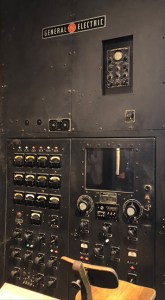
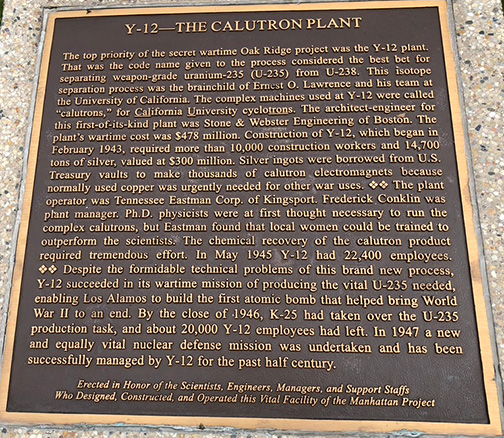
A bus tour through and around the old facilities, Y-12, X-10, and K-25, provided a sense of the scale of facilities needed to get the work done. We learned about the number of people working each shift, how most workers lived on-site, and how they kept the city secure during WWII, with stops along the way to visit various facilities. A visit to the old Alexander Hotel, now a senior home, yielded more pictures and history, and wayside markers around Oak Ridge provide additional information on the work done here.
To learn more about Oak Ridge, visit https://exploreoakridge.com/. Information on the Manhattan Project at Oak Ridge, Los Alamos, and Hanford is available at https://www.nps.gov/mapr/index.htm.
 A. E. Macdonald's Writing Life
4 responses to “Uncovering Family History: My Grandfather’s Engineering Legacy”
This has been amazing to read. My grandfather was an engineer at Chapman Valve and one of the employees tasked with top secret MP work. My understanding is he worked on valve designs and production. But he was also gone for a very long trip. My mom recalls her dad arriving at their home in a vehicle stripped of the exterior front body (open air driving) and a large lead box welded to the back trunk area. With the uranium work that Chapman Valve also completed along with valve work (rod production is my understanding from the USGov health settlements) a large lead box makes sense. He was home just to say good-bye with an awareness of the possibility he may not return. He was gone for quite a long time as my mom would recall. As I dig through family files, I hope to find out more information. I do have my grandfather’s Manhattan Project certificate, but I do not think we still have his atomic pin. I recall him using it as a fishing weight which is a story for another day.
Thank you for reading and for your comments. That is an amazing story to tell about the lead box and not seeing your grandfather being away with the possibility of never returning. I like how he used the A-Pin as a fishing weight too. These men did a lot and, in the end, the pin wasn’t something you could wear around the house but had many other uses.
William Bill Shackleford, received a certificate from the United States of America. Of when he helped design the Trigger mechanism of the atomic bomb. I was told that me and my siblings could received Royalties from our grandfather how do i get a copy of that certificate
Hi Cathy,
Thanks for reaching out. My research was conducted by searching through records at the National Archives. I’m not sure how you would access that certificate today. Have you reached out to the Department of Energy?
Best,
Anne