
National Archives Atlanta
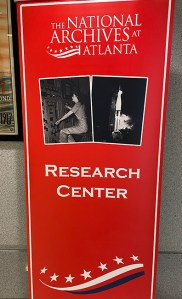
My next step was to visit the National Archives in Atlanta. I was unsure if I would find the information I needed among the 7,700 folders and binders in 184 boxes, but I was prepared to try. I booked my flight, reserved a hotel, and reviewed the finding aid for a research trip scheduled for April 20, 2020. However, soon after making arrangements, flights were canceled, hotel reservations were refunded, and the archives closed to visitors. As pandemic restrictions persisted through 2021 and into 2022, I repeatedly postponed the trip. When the archives reopened in late March 2022, I promptly reserved the week of April 4, nearly two years after my original plan.
While waiting for the research room to reopen, I contacted the Atlanta archivist to inquire about online access to the collection. The archivist found that Mac was posthumously awarded a silver “A” award and pin in March 1946 for his eleven months of work on the Manhattan Project with the Tennessee Eastman Corporation. This suggested there may be additional relevant information at the Atlanta archives.
The A Pin
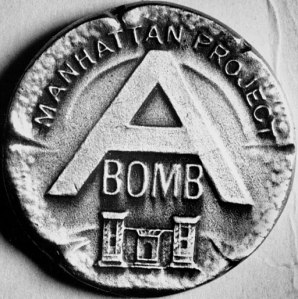
(Please see my piece on the “A” award.) This provided a sense that there may be more information at the archives in Atlanta.
Preparation
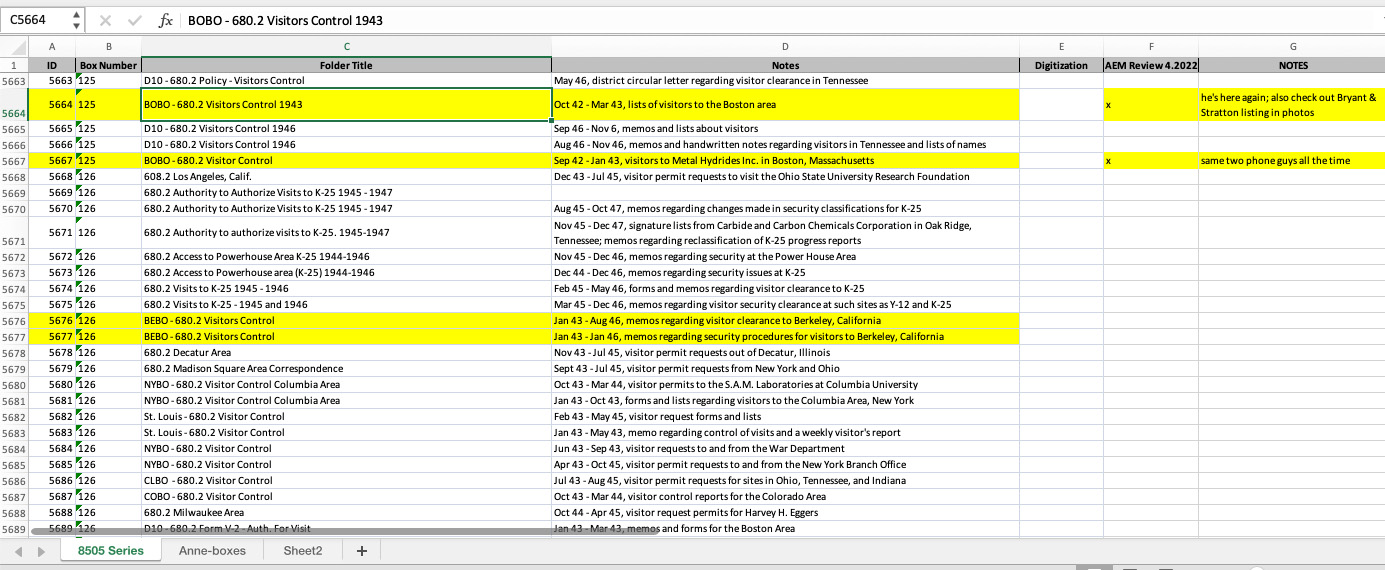
With my research appointment approaching, I reviewed the finding aid, an Excel spreadsheet containing 7,700 entries, each representing a folder with its title and description. To select relevant files, I searched for keywords such as ‘Stone and Webster’, ‘Tennessee Eastman Corporation’, ‘Boston’, ‘Oak Ridge’, ‘cubicles’, ‘procurement’, ‘expediting’, ‘deaths’, and ‘insurance’. I prioritized procurement and expediting because his death certificate and Department of Energy documents indicate he was a field expediter for the Tennessee Eastman Corporation at the time of his death, and expediting falls under procurement. I included Stone and Webster since he previously worked there, and cubicles because he frequently traveled to Pittsfield and Springfield, Massachusetts, where most calutron cubicle parts were produced. Boston was relevant because it was the location of the Manhattan Project’s New England office. I also searched for death and insurance to identify any information about reported deaths or insurance payments.
After a week of reviewing the finding aid, highlighting files, and recording box numbers, I compiled a list of 103 boxes. Reviewing all of them in four and a half days would require examining 20 to 25 boxes daily, which was not feasible. I refined my list by selecting boxes with multiple highlighted folders or those that appeared most relevant. I then sent a revised list of 48 boxes to the archivist, making the task more manageable within my available time. This ensured the boxes would be ready upon my arrival.


4 responses to “Uncovering Family History: My Grandfather’s Engineering Legacy”
This has been amazing to read. My grandfather was an engineer at Chapman Valve and one of the employees tasked with top secret MP work. My understanding is he worked on valve designs and production. But he was also gone for a very long trip. My mom recalls her dad arriving at their home in a vehicle stripped of the exterior front body (open air driving) and a large lead box welded to the back trunk area. With the uranium work that Chapman Valve also completed along with valve work (rod production is my understanding from the USGov health settlements) a large lead box makes sense. He was home just to say good-bye with an awareness of the possibility he may not return. He was gone for quite a long time as my mom would recall. As I dig through family files, I hope to find out more information. I do have my grandfather’s Manhattan Project certificate, but I do not think we still have his atomic pin. I recall him using it as a fishing weight which is a story for another day.
Thank you for reading and for your comments. That is an amazing story to tell about the lead box and not seeing your grandfather being away with the possibility of never returning. I like how he used the A-Pin as a fishing weight too. These men did a lot and, in the end, the pin wasn’t something you could wear around the house but had many other uses.
William Bill Shackleford, received a certificate from the United States of America. Of when he helped design the Trigger mechanism of the atomic bomb. I was told that me and my siblings could received Royalties from our grandfather how do i get a copy of that certificate
Hi Cathy,
Thanks for reaching out. My research was conducted by searching through records at the National Archives. I’m not sure how you would access that certificate today. Have you reached out to the Department of Energy?
Best,
Anne