
The journey that led to my book, ‘The Macdonalds of Cedar Park,’ started when I tried to find out which part of the Manhattan Project my grandfather worked on during World War II. As kids, my cousins, siblings, and I knew our grandfather, Donald L. Macdonald, Sr.—everyone called him Mac—had been involved in the Manhattan Project, but secrecy kept us from learning much. He took most of the details with him when he passed away. My father, who worked as a teenage courier in the Manhattan Project’s Boston office, knew a bit more, but he rarely shared any details. When he did, it often took some effort to get him to open up again.
When Mac died, my grandmother was 48, my father was 16, and my uncle was 21 and serving with the 10th Mountain Division in Italy. His death came as a shock to everyone who knew him. My grandmother saved the sympathy cards and letters she received to remember how people felt about his passing. She also kept more than 140 letters my uncle sent home between 1943 and 1946, which talked about family, friends, and people in and around Melrose.
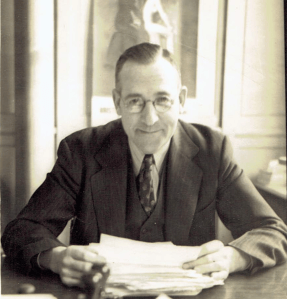
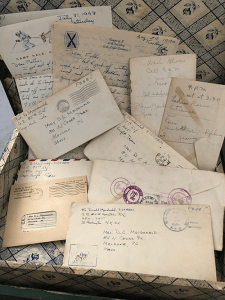
Between 2017 and early 2020, I copied, scanned, and read every letter and sympathy card I could find, hoping to learn more about my grandfather and his work on the Manhattan Project. By tracing the names, places, and events mentioned, I pieced together where Mac was, what he was doing, and how his work fit into the Manhattan Project.
My grandfather was born in Cambridge, Massachusetts, to a train engineer and a housewife. The family later moved to Somerville, where he went to local schools and graduated from Somerville High School in 1916—the same year as my grandmother. That fall, he started at Tufts Engineering as part of the Class of 1920. While waiting to join the U.S. Navy in November 1918, he learned that World War I had ended. Instead of returning to Tufts as a student, he chose to keep working as a surveyor and drafting instructor at Tufts, becoming a ‘2-year man.’
He spent most of his career as an inspecting engineer, ensuring projects and products met safety rules, industry standards, and design plans. He usually worked on-site, checking materials, making sure everything worked, and keeping records. Whenever he was away, he wrote letters to my grandmother about where he was, who he met, and how late he stayed up writing reports. He started out as a surveyor and instructor, first at Tufts from 1918 to 1919, then at Franklin Union from 1921 to 1924. He worked for Stone and Webster Engineering, and later became the New England Manager of the Pittsburgh Testing Labs. One of his jobs there was to inspect all new bridge construction in the state. In September 1928, he wrote an article for the Journal of the Boston Society of Civil Engineers called “The Inspection of Structural Steel.”
In 1933, the family moved from Belmont to Melrose, Massachusetts, where my grandmother’s sister and her family already lived on Lebanon Street. When the Depression forced Pittsburgh Testing Labs to close, he, his wife, their two sons, and his mother moved to Chicago. There, he worked for the American Dairy Council for 18 months. The family returned to Melrose in 1937, and he took a job with the American Security Fence Company. This job allowed him to work on his own projects, like overseeing the construction of steel frames for houses in Melrose for a contractor in Wellesley, Massachusetts. I plan to write more about this in another article soon.
As the United States sent more supplies overseas for the war, steel became harder to get. Stone and Webster increased their staff for projects that supported building and shipping supplies to the European Allies during World War II. At that time, he returned to Stone and Webster Engineering as an inspecting engineer.
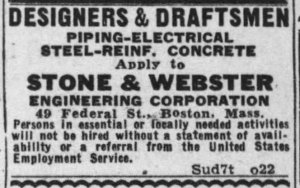
The effort to develop atomic weapons became official after the Japanese bombed Pearl Harbor on December 8, 1941, bringing the United States into the war. This effort, called the Manhattan Project, was a joint project between the US, Britain, and Canada to build the first atomic bomb. The Army Corps of Engineers managed it under the Office of Scientific Research and Development (OSRD).
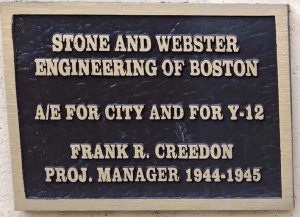
The Manhattan Project set up offices across the country to work directly with engineering and manufacturing firms that served as contractors and subcontractors. Colleges and universities also conducted various experiments and assessments.
From 1942 to 1946, Boston housed a Manhattan Project office. Stone and Webster Engineering Corporation, based in Boston and with offices nationwide, became the project’s first main contractor. Their biggest jobs were planning and building the city of Oak Ridge, Tennessee, and developing and constructing the Y-12 plants there, as well as the calutron cubicles used to manually seperate uranium 238 from U235. General Leslie Groves became the project director in August 1942, after the project had already started.
 A. E. Macdonald's Writing Life