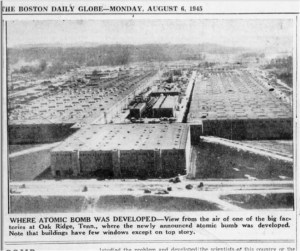
The journey that led to my book, ‘The Macdonalds of Cedar Park,’ began when I tried to determine which part of the Manhattan Project my grandfather worked on during World War II. After reviewing all the letters, I examined original Manhattan Project records, especially those from Oak Ridge, Tennessee. Most Manhattan Project records are held at the National Archives, with regional branches organized by where the work was conducted. The Atlanta branch holds Oak Ridge files covering the Southeastern United States. Files from the Office of the Chief Engineer in Boston are mainly at the Boston branch, with some also in Atlanta. The more sensitive files are stored at the College Park, Maryland, facility and are not available for review.
At the Boston Office, housed in Waltham, MA, I gained valuable insights into establishing the Manhattan Project office in Boston, the rapid assignment of tasks, the acquisition of buildings, and the large monthly increases in staffing, especially of draughtsmen, stenographers, and typists.
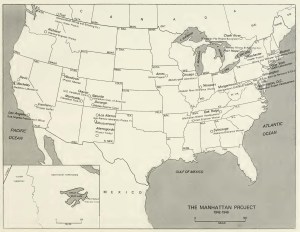
In August 2018, I traveled to Washington, DC, and spent two days at the National Archives in College Park, Maryland. The archives house a wide variety of project documents, including sensitive and still-restricted materials. Despite dedicating a full day to reviewing thousands of photographs from Oak Ridge, Tennessee, I did not find any records directly related to Mac.
While visiting Oak Ridge, Tennessee, I learned about the town’s role as a ‘secret city’ built to support three major facilities, each producing enriched uranium by different methods, as well as the city built to support workers and the housing provided for project workers.
At the Oak Ridge History Museum in the Midtown Community Center, a volunteer clarified details about Mac’s employment card. I learned that every visitor and resident of Oak Ridge was assigned a badge and number. Mac’s relatively low number confirmed his early access to the project.
Before visiting the National Archives in Atlanta, I reviewed the finding aid, an Excel spreadsheet containing 7,700 entries, each representing a folder with its title and description highlighting keywords such as ‘Stone and Webster’, ‘Tennessee Eastman Corporation’, ‘Boston’, ‘Oak Ridge’, ‘cubicles’, ‘procurement’, ‘expediting’, ‘deaths’, and ‘insurance’.
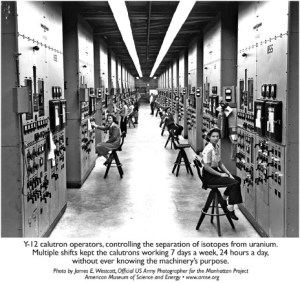
I prioritized procurement and expediting because, at the time of his death, Mac was a field expediter for the Tennessee Eastman Corporation, and expediting falls under procurement. I included Stone and Webster since he previously worked there, and cubicles because he frequently traveled to Pittsfield and Springfield, Massachusetts, where most calutron cubicle parts were produced. Boston was relevant because it was home to the Manhattan Project’s New England office. I compiled a list of 103 boxes, then realized that reviewing that many boxes in four and a half days would require examining 20 to 25 boxes daily. I further refined the list to 48 boxes, which I thought would make the task more manageable. I worried I hadn’t selected the right files. Could I locate information about my grandfather by reviewing only a quarter of the materials? Although it seemed unlikely, I decided it was worth the effort.
At the National Archives in Atlanta, I was pleased to find my grandfather’s name in the second box, listed among Stone and Webster employees working on the Manhattan Project for the week ending July 3, 1943. He served as the resident inspector at Chapman Valve Company in Indian Orchard, Massachusetts. On the last day of my research, I found Mac in the Tennessee Eastman Corporation monthly history summaries from 1944 and 1945. When the project shifted from Boston to Oak Ridge in August 1944, Mac moved to the newly created Tennessee Eastman Corporation role of field office procurement representative for District No. 1 in Boston, Massachusetts, representing all Boston-related projects at Oak Ridge, Tennessee.
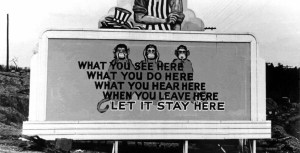
As part of a secret project, he worked on one of the secret cities. At the time, Mac was home only on occasional weekends. When he was home, someone was stationed outside the family home in Melrose, watching him and anyone visiting the house. While my grandmother and father were happy to have him home, they chafed under the security restrictions and couldn’t explain why security was outside the house so often. Secrecy was so tight that one of the Boston-based security officers moved from Brookline to Melrose. I don’t think that was a coincidence, especially since the letters mention this security officer.
When the first atomic bomb was dropped on August 6, 1945, the world learned what all the secrecy was about. The Army had prepared press releases and sent them to all the Boston newspapers, describing the work at Oak Ridge, Tennessee, and the roles of Stone and Webster Engineering, General Electric, Westinghouse, and Chapman Valve. Now everyone knew what my grandfather had been working on during the war years.