
To support the war effort, the government rationed critical supplies such as tires, gasoline, sugar, meats, fats, coffee, and shoes. Rationing was overseen by the Office of Price Administration (OPA), which issued ration books to every civilian, including infants, with points and stamps to be handed in, along with cash, to purchase limited goods. The OPA also set ceiling prices for all items to help curb the black market.
The first items rationed were tires and rubber, beginning in January 1942; automobiles in February 1942; gasoline and sugar in May 1942; and coffee in November 1942. Cheese, canned milk, and fats such as butter, lard, and oil were rationed beginning in March 1943, along with meats and canned fish. Poultry, rabbits, eggs, fresh fish, and shellfish were not rationed, although many people had chickens and rabbits at home for eggs and meat. With metals, including tin and steel, rationed, canned goods were less available than before, and the number of tin cans you put out for collection was monitored to discourage hoarding.
By the end of the war, there were 5,600 ration boards across the United States involving more than 100,000 people. Ration books, such as the ones pictured here, were issued for periods of 6 months or more. Book One, issued in May 1942, was mostly for sugar and coffee.
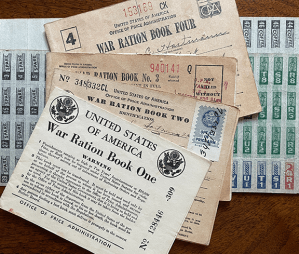
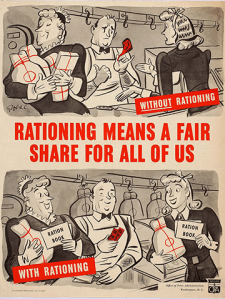
Book Two, issued in January 1943, included colored point stamps, such as blue for processed foods and red for meats, to help manage shortages. Book 3, issued in September/October 1943, had stamps labeled with letters (A-Z) indicating the time period during which they were valid. Book 4 was issued in late 1943 to track the fluctuating point values for many different goods. In 1943 and 1944, many rationed food items were made available on specific weeks of the month. Local grocery stores advertised the weeks when a rationed item would be available, along with the number and type of coupons needed for each item. Book 5, printed in 1945, but never distributed. In addition to newspaper articles, the OPA produced posters, such as the one above, that promoted the fairness of rationing for all.
Rationed non-food items included the previously mentioned items, as well as tires, cars, and bicycles. In addition, gasoline, fuel oil, kerosene, and coal were rationed, along with stoves, leather footwear, and typewriters. To preserve fuel oil, the maximum home temperature setting is 55 degrees. To preserve gasoline, the speed limit was set to 35 miles per hour.
The OPA implemented gasoline rationing in May 1942. Owners registered their vehicles and received ration books with coupons, along with a sticker to display on their cars. Most owners received an “A” sticker, allowing 3-4 gallons of gas a week for shopping, church, etc.
War workers and those who commuted with at least three passengers were issued “B” stickers for up to 8 gallons a week. Essential workers, such as doctors, clergy, mail carriers, and construction workers, received “C” stickers for 8 or more gallons per week. Essential government workers and emergency services received “X” stickers and were allowed to purchase unlimited amounts of gasoline. My grandfather, living here in Melrose and working on the Manhattan Project for Stone and Webster Engineering in Boston, traveled frequently to Springfield, Massachusetts, to work with vendors on the components needed to separate uranium, and had unlimited gasoline privileges. He was able to send gasoline coupons to his son, who was training with the 10th Mountain Division at Camp Hale in Pando, Colorado. When my grandfather accepted a desk job in September 1943, he voluntarily turned in his “X” sticker to do the right thing for the war effort, to the dismay of his wife and sons.
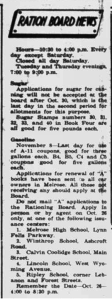
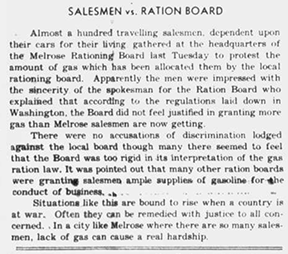
Melrose had the local War Price and Rationing Board with issuance centers at each of the schools in Melrose and a permanent office in the Coolidge School. The Coolidge office was open daily except Saturday from 10:30 – 4 pm, and on Tuesday and Thursday evenings from 7 – 9 pm, to answer questions, accept applications, issue ration coupons, and handle complaints. The Melrose Free Press had a weekly column titled “Ration Board News” to provide the latest ration news and updates. When 100 traveling salesmen in Melrose approached the Rationing Board on a Tuesday evening to protest the amount of gas they were allotted for their work, they were so impressed by the sincerity of the Rationing Board spokesperson that they did not lodge a formal complaint. Still, they indicated that other towns were more generous with gas rationing.
President Truman ended rationing in November 1945, although sugar rationing continued in some areas until 1947.

