
As soon as war was declared on December 8, 1941, restrictions on goods to support the war effort began.
The first mention of scrap salvage appears in the January 9, 1942, edition of The Boston Globe. By January 21, 1942, salvage committees for each major industry—iron, steel, rubber, paper, and other war-related materials—had been established. The first item affected was tires for both bicycles and cars. Tires, made of rubber, were severely restricted when Japan conquered Southeast Asia, cutting off American and Allied rubber supplies from Malaya and the Dutch East Indies. Excess car and bicycle tires were confiscated, and new tires, including retreads, were rationed.
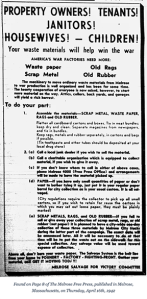
Rubber was needed for military equipment, including tires, tank treads, and gas masks. An airplane required hundreds of pounds of rubber for tires, hoses, and wire insulation. A tank required a ton of rubber. A battleship needed 75 tons. Life rafts and boots also required rubber.
To meet these military needs, tires were strictly controlled. Each vehicle was restricted to five tires: four on the vehicle and one spare. Melrose, like most cities and towns, established a tire committee. The committee checked homes to ensure there were no extra tires and handled requests for new ones. Each month, the supply of new and retreaded tires was distributed based on need, with doctors given top priority.
Bicycle tires were also restricted, with priority given to essential workers such as mail carriers, messengers, and factory workers for new tires. Most auto and bicycle factories were converted to war production, which limited the supply of new cars and bicycles. Those that were produced were modified to use less steel and rubber.
Scrap drives to collect iron and steel, as well as non-ferrous metals such as brass, copper, zinc, lead, and aluminum, excluding tin cans and razor blades, waste paper, cotton, and woolen rags, were underway by April 1942. Scrap metal was sent to industrial mills to be forged into military equipment such as armor plating, tanks, ships, and ammunition.
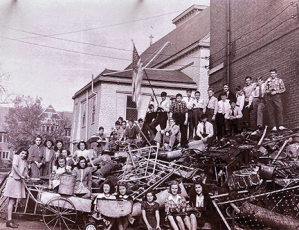
The photograph of students at St. Mary’s School standing beside and atop the metal scrap pile shows a wide variety of metal items gathered for the scrap metal drive.
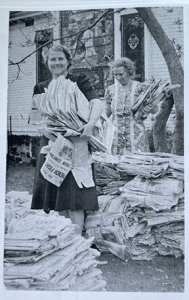
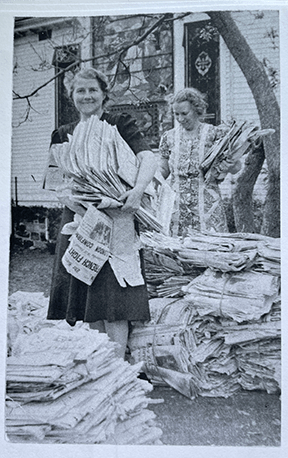
Newspapers were collected and recycled to produce cartons for shipping munitions, spare parts, and rations, as well as paper for military record-keeping, map production, and packaging. They were also used for asphalt roofing and wallboards for temporary military barracks, field hospitals, and housing in Manhattan Project-related cities such as Oak Ridge, Tennessee; Los Alamos, New Mexico; and Hanford, Washington.
The photograph depicts women gathering and organizing newspapers for the paper drive at the Green Street Baptist Church in Melrose.
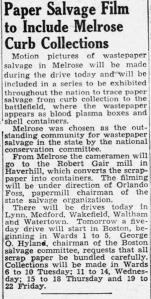
In May 1945, Melrose was featured in a movie that traced waste paper curb collection from pick-up to delivery at the Robert Gair Mill in Haverhill, MA, where scrap paper was turned into blood plasma boxes and shell containers. Melrose was recognized by the National Conservation Commission as the outstanding community for waste paper collection in the state.
Waste cooking fats were collected, and the glycerin was extracted for use in explosives such as nitroglycerin, bullets, and artillery shells. Soldiers used the grease in Spam cans to waterproof their boots and grease their guns. My parents, Dad was from Melrose, and Mom was from Lynn, remembered that their parents each kept two coffee cans of fats. One for home and one to be turned in for the war effort. Grease was collected and taken to a local butcher, who weighed the waste fats and paid four cents a pound.
Households were responsible for conserving tin cans and toothpaste tubes. Tin cans were steel cans with a tin lining, which was resistant to corrosion by food acids, making them ideal for sending C-rations and K-rations to soldiers and sailors overseas. As rationing increased, more vegetables were grown and eaten at home or canned in glass jars. When your toothpaste tube was empty, you took it to the drugstore to have toothpaste pumped into your existing tube. Cotton and wool rags were also collected, shredded, and spun into recycled fibers for uniforms and heavy-duty cleaning cloths for machinery.
Boosting morale was another advantage of salvaging materials. People who normally wouldn’t serve felt they were helping the war effort.
This article is based on research the author, A. E. Macdonald, conducted for The Macdonalds of Cedar Park, a novel based on her Melrose-based family during WWII. The scrap metal and paper drive images are courtesy of Scott Macauley with the permission of David Hamilton.

