
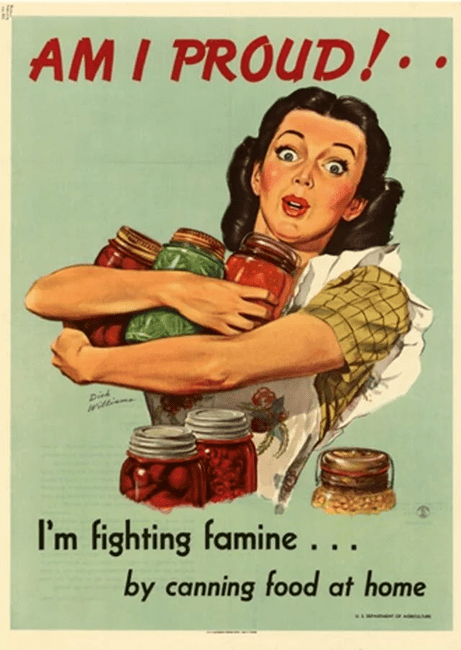
Victory Gardens were vegetable, fruit, herb, and flower gardens planted during wartime in private yards and public spaces, including patios and rooftops. During WW1, they were called War Gardens for Victory. During WWII, the name was shortened to Victory Gardens. In 1942, the push to grow your own food was encouraged as a part of Civil Defense through the Civil Defense Women’s Division, but it was not mandatory.
In January 1942, the Boston newspapers began focusing on the need for victory gardens. The first mention of the term “Victory Garden” in the Melrose Free Press is in a Whittemore Hardware advertisement. While rationing had started, the need to grow your own food was either already known or hadn’t reached the level of attention it would gain in the following war years.
On June 13, 1942, a parade of Melrose civilian defense units featured the Auxiliary Police and Air Raid Wardens first, followed by the Auxiliary Fire, medical, rescue, engineering, and utilities units. The Women’s Division, including Victory Garden, Salvage, and Nutrition Units, marched third.
As a further indication of the garden movement’s momentum, by early July, homes for sale in Melrose noted that there was space for a ‘victory garden’ in their advertisement.
On August 13, 1942, the Melrose Free Press reprinted a Boston Herald article about a West Wyoming Street resident who was growing a magnificent garden on his backyard piazza, with 25 potted tomatoes lining 3 sides, along with parsley, cucumbers, radishes, pole beans, and some flowering plants. In September 1942, the Melrose Garden Club had its annual flower show with a victory garden category for those under 16. In late September 1942, two men from Melrose won the blue ribbon from the Massachusetts Horticultural Society Victory Harvest contest for their work on a half-acre of land in Lynnfield, with a full quarter-acre devoted to potatoes. Their winning entry was showcased in the window of Whittemore Hardware.
In December 1942, the Women’s Civilian Defense Victory Garden team noted that they would be providing classes to anyone with a plot of land they could use to grow their own vegetables. The article notes that growing vegetables went from a voluntary effort to an absolute ‘must’ per the government.
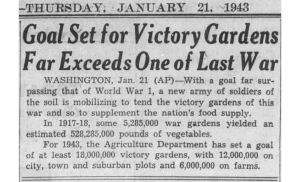
In January 1943, the Secretary of Agriculture asked for 18,000,000 war gardens in the 1943 growing season. The Mayor’s Victory Garden committee, formed in early 1943, encouraged as many victory gardens as possible. Mrs. Gladys Boland, the Chair of the Victory Garden committee in 1942, became Co-chair of the Victory Garden Committee, sharing those duties she had performed by herself with William A. Dole, Jr.
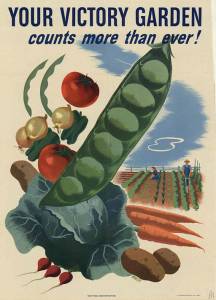
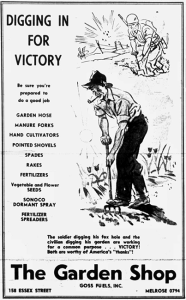
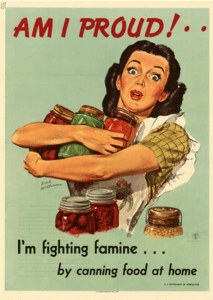
As food shortages developed rapidly, growing food would make a significant contribution to the war effort. The government provided colorful posters to promote victory gardens. Advertisements drew the connection between digging in the garden and soldiers digging foxholes. The Boston Globe and the Boston Herald published many articles on how to plant and care for a Victory Garden. Many companies advertised fertilizers that let you grow in any dirt, anywhere.
By March 1943, the call went out for anyone in Melrose with land to lend, lease, or rent to inform the committee. Beginning in April, the Melrose Grange ran articles in the Free Press on how to prepare soil for growing, how deep to plant seeds, and said the best crops for the home gardener were tomatoes, radishes, pole beans, summer squash, and cucumbers. For most of 1943, the Melrose Free Press ran a regular “Victory Garden News” column, sharing available gardening land, planting tips, and the recommended ‘Big Six’: tomatoes (12 plants per person), cabbage, lettuce (staggering for summer supply), beans, carrots, and Swiss chard. The Middlesex County Extension Service and a local consultant offered expert advice. WEEI had a semi-regular radio show, “Victory Garden Times.” My grandmother became skilled at growing and canning tomatoes, leading to ongoing debates with my father, who rarely ate them except on pizza.
When it quickly became apparent that home victory gardens were at risk of being trampled by local dogs, destroying the work homeowners had begun, the Board of Aldermen held a public hearing on how to prevent dogs from ruining victory gardens. Melrose was one of the few cities or towns without legislation requiring dogs to be kept from running loose. There was no conclusive change from this meeting.
By 1944, the number of Victory Garden articles decreased, even as the Melrose Garden Club continued to host numerous lectures on Victory Gardens, highlighting successful gardeners and offering instruction.
Once the war ended in August 1945, the term ‘victory garden’ disappeared from the newspapers. However, the legacy endures; the oldest, ongoing victory garden is the Fenway Victory Gardens in Boston.

