
As we prepare for the holidays, it is important to remember the past. War is not only about heroes and actions; it is also about loss and remembering those missing from our lives and our tables- those who fought and are still considered missing in action or prisoners of war. Many may not be remembered, but the military does its best to honor them with a ceremony called the Missing Man Table.
Also called the Fallen Comrade Table, the Missing Man Table is usually shown at formal military dinners, banquets, and memorial events to honor service members who are missing in action, prisoners of war, or who gave their lives in service to their country. Displays are also found at Senior Centers and Veteran Centers, including the Malden, MA, and Ipswich, MA, Senior Centers.
More than 81,000 service members are still missing from major U.S. conflicts in the late 20th Century. Efforts continue to bring soldiers back to their families for burial.
The breakdown is as follows:
- World War II: more than 71,000 missing, including 19 Women’s Army Corps (WAC) members, who went missing in June 1945 when their transport plane crashed in Europe.
- Korean War: approximately 7,300 missing
- Vietnam War: about 1,500 missing, including military women who mostly served as nurses in Vietnam
- Cold War and the two Gulf Wars: have fewer missing, totaling less than 150.
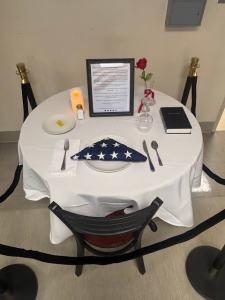
The Missing Man ceremony involves a table with one place setting, where each part of the table carries symbolic meaning as described below.
This image is from the Ipswich, MA, Senior Center Missing Man placesetting.
- The Table represents the everlasting concern and remembrance for those who remain missing.
- The White Tablecloth symbolizes the purity of intention with which service members answered their nation’s call.
- The Single Red Rose honors the loved ones who continue to keep faith while awaiting answers.
- The Yellow Ribbon represents hope for the safe return of those who remain missing.
- The Slice of Lemon serves as a reminder of the bitter fate endured by those who were captured or are missing.
- The Pinch of Salt symbolizes the tears families shed through years of uncertainty and waiting.
- A Book of Faith is optional. If used, it reflects the strength and comfort found through faith.
- The Inverted Glass signifies that the missing cannot be present to share a toast.
- The Empty Chair represents those who are absent but never forgotten.
You can learn more at:
- National Association of POW/MIA families at https://www.pow-miafamilies.org/the-missing-man-table
- POW/MIA Memorial Association at https://powmiamemorial.org/learn/the-missing-man-table/
- As well as a variety of other websites.
Thanks to Scott Macauley for inspiring this story.

