
When Germany declared war on the United States on December 11, 1941, in support of their agreement with Japan, there was concern about the amount of goods America shipped to the European Allies across the North Atlantic. The need for local civil defense to manage potential enemy attacks on American soil was already underway.
Newspapers and radio broadcasts followed reporters such as Edward R. Murrow and Ernie Pyle as they covered London air raids and blackouts in 1940 and 1941. At the first meeting of the Committee on Civil Defense, the Melrose Free Press noted: “More than one speaker stressed the point that though the invasion and bombing of America seem extremely remote to the average citizen, facts uncovered by government intelligence agencies show that the success of Germany against England and Russia would put America and especially New England in immediate danger, hence the need for volunteer workers.”
The Melrose Committee on Civil Defense prepared for any eventuality. Volunteers were organized into air-raid wardens, auxiliary police, auxiliary firemen, and first-aid providers. By August, sixteen Melrosians had graduated from Air Raid School. At least the same number of women had graduated from Women’s Civilian Defense School in Boston. Of those solicited, 207 men enlisted as Auxiliary Police. The YMCA trained men, women, and children in first aid. They planned to instruct each ward and precinct in Melrose. There was a search for men to volunteer as auxiliary firemen. Melrose began its first Women’s Civil Defense School in September 1941, holding day classes at the Washington School and starting night school in October.
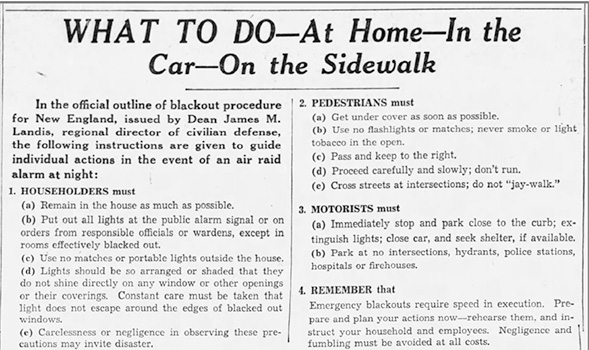
The Thursday, December 11, 1941, edition of the Melrose Free Press announced that the first air raid test would take place on Saturday, December 13, from 1:00 to 1:15 pm, with the air raid siren sounding from City Hall, the fire stations, and a fire truck patrolling more remote areas of Melrose. Melrose quickly established air-raid wardens by ward and precinct to handle initial air-raid testing, blackout testing, and blood donation. On January 5, 1942, the basic guidelines for blackouts were printed in the newspapers. Each town, including Melrose, tested air raid signals during the day and at night.
While not widely reported at the time, German U-boats (submarines) were monitoring shipping along the East Coast from Maine to North Carolina, attacking US ships carrying supplies to England. The threat of Hitler sending planes to bomb us was a commonly held theory.
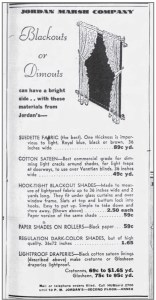
Melrose held its first blackout test on Tuesday, March 10, 1942, from 10 to 10:15 pm. The role of air raid wardens was to prevent panic and ensure that all home and apartment lights were extinguished as quickly as possible. All vehicles were to stop, pull to the side, and extinguish their lights; no smoking or lighting of matches outdoors was permitted. Streetlights were turned off. Planes would fly overhead to create the effect of an air raid. The blackout test was considered to be a great success.
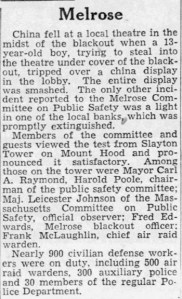
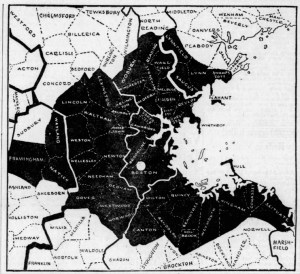
Melrose participated in a metropolitan-wide blackout held on March 31, 1942, which covered 600 square miles, making it hard for planes or U-boats to pinpoint cities and the coastline. Air Raid and blackout testing continued throughout the war.
While no East Coast city was bombed, U-Boat activity persisted. In June 1942, a U-Boat laid 15 mines at the entrance to Boston Harbor. The mines were poorly placed and did not sink any ships. In response, the U.S. Government deployed controlled submarine mines off Georges, Great Brewster, Deer, and Outer Brewster to secure Boston Harbor. No U-boat entered the harbor. However, several ships were sunk near Boston. U-Boats sank 1,458 US ships off the East Coast.
Melrose held their last blackout test in late March 1944. The last air raid test was also in 1944. However, air raid signals announced the end of the war in Europe in May 1945 and the end of the war with Japan in August 1945.
 A. E. Macdonald's Writing Life